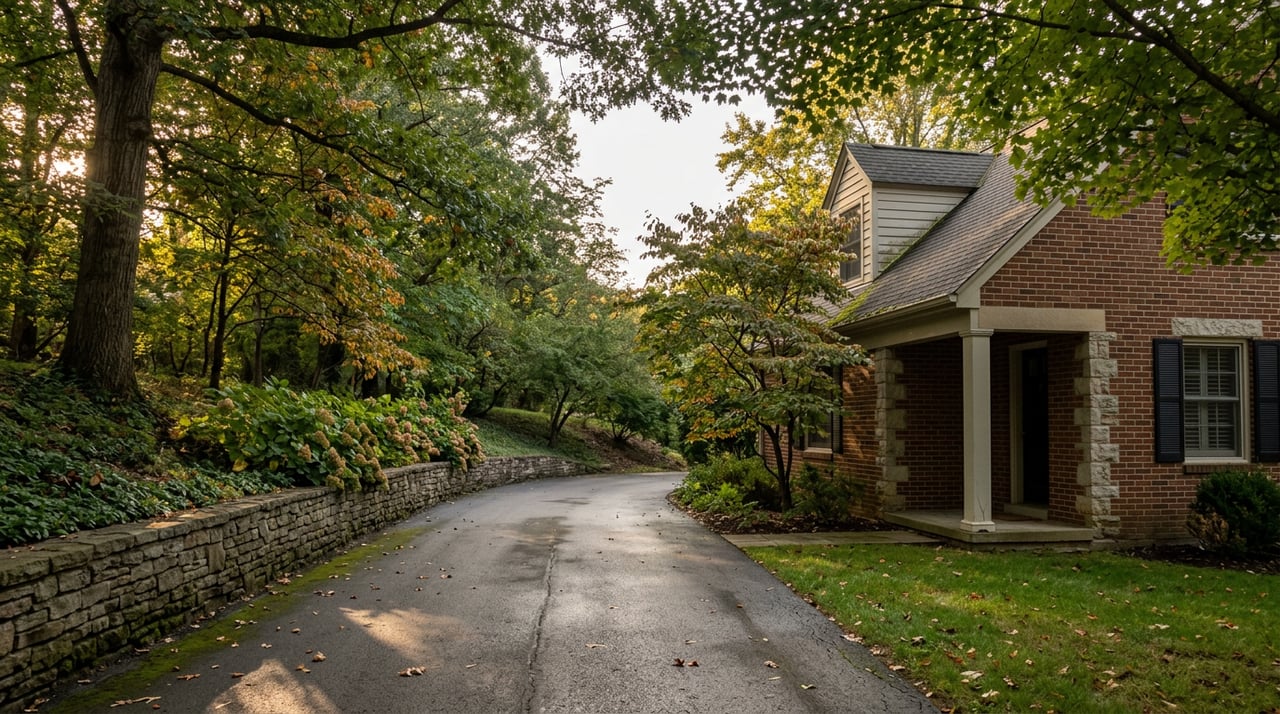
Two buyers can write offers on nearly identical Fox Chapel homes, both on the same quiet lane, both with strong credit and clean pre-approvals, and still land on completely different closing timelines. The difference almost never comes down to the house. It comes down to which loan program each buyer chose, and whether that particular lane has ever had a recorded agreement spelling out who pays to fix it when it washes out.
Fox Chapel Borough was built around privacy. Wooded lots of an acre or more, curving lanes tucked behind mature tree canopy, and a zoning code that has protected steep slopes and rural character for decades all point toward the same practical outcome: a real share of the borough's addresses sit on private roads rather than borough-maintained streets. The private road itself is not the risk. The risk is a paperwork question almost nobody raises before they are already under contract: does a recorded maintenance agreement exist for that lane, and does the buyer's loan program require one to close.
The Named Lanes Behind the Big Estates
This isn't an abstract Pennsylvania issue that happens to touch Fox Chapel. It has a documented local history. In 2021, Fox Chapel Borough Council voted to rename Squaw Run Road, removing a slur from the map and replacing it with Hemlock Hollow Road, chosen for the native Eastern Hemlock threatened by an invasive insect tied to a warming climate, as TribLive reported. At the same meeting, council approved new names for 12 private lanes branching off Squaw Run and Squaw Run East, affecting roughly ten properties along with the homes on the Heinz Estate, according to TribLive's coverage of the process. One of those newly named lanes, Benedum Lane, leads to Shady Side Academy Middle School.
Twelve private lane names, renamed in a single council action, on a single corridor of the borough. That is not a hypothetical edge case buried in a mortgage handbook. It is a working description of how Fox Chapel is actually built: clusters of homes sharing a private access road that the borough itself does not maintain, plow, or accept liability for.
What Fox Chapel's Own Code Already Tells Buyers
The borough's subdivision ordinance is specific about this. Under Fox Chapel's own code, before any lot on a private road or lane can be sold, the developer must notify the purchaser in writing that the road is private and that the borough will not accept it for public dedication or maintain it as a result. That same notice has to appear again in the deed at the time of conveyance. The code also gives the borough sole discretion over whether it ever accepts a private road for public dedication and winter maintenance, and separately requires a working fire hydrant within 600 feet of every buildable lot regardless of who owns the road leading to it.
That notice tells a buyer something true and important: this road is yours to maintain, not the borough's. What it does not tell a buyer is whether their mortgage will actually go through. Those are two separate questions, and conflating them is where deals lose weeks.
The Same Road, Five Different Rulebooks
A private lane in Fox Chapel does not get evaluated once. It gets evaluated differently depending on which loan program is financing the purchase, because each major program has its own rule for what "acceptable access" means.
| Loan Program | Private Road Requirement |
|---|---|
| Fannie Mae (conventional) | Requires a legally enforceable, recorded agreement or covenant for street maintenance |
| Freddie Mac (conventional) | Does not require a maintenance agreement |
| FHA | Requires a recorded permanent easement for ingress and egress; does not require a maintenance agreement |
| USDA | Requires a recorded easement; a maintenance agreement is not mandatory, though individual lenders may still ask for one |
| VA | Requires a recorded joint maintenance agreement and an all-weather surface, though VA can approve a waiver based on the specific facts |
This split is confirmed across multiple lending guides, including a breakdown of USDA, FHA, VA, and conventional private road rules and a summary of HUD Handbook 4000.1 and USDA Handbook 3555-1 language on shared driveway easements. Two buyers, same lane, same seller, and one closes on schedule while the other is waiting on a document that may not exist yet, purely because of which box they checked on their loan application.
The Pennsylvania Association of Realtors has documented how disruptive this gets in practice. A Centre County agent reported a client whose underwriter would not approve the loan until an agreement was reached with at least 18 of the 20 owners who shared the road. That case sat outside Fox Chapel, but the mechanism is identical to what happens on any of the borough's named private lanes when a conventional loan is in play and no signed agreement is on file.
What Changed in 2021, and What It Didn't Fix
Pennsylvania tried to close this gap the same year the borough was renaming those lanes. Act 75 of 2021 amended the state's Private Road Act, took effect in December 2021, and created a statutory fallback: where no written maintenance agreement exists, each property owner who benefits from a private road is now required by law to contribute toward its upkeep in proportion to how much they use it, with the right to sue a neighbor who refuses. The full statutory language is on file with Justia.
A written agreement is no longer the only way to establish shared responsibility.
That is how the Greater Harrisburg Association of Realtors describes the shift: homeowners on a lane without a signed agreement are now automatically bound by a statutory maintenance obligation, with the right to sue a neighbor who won't pay their share, and the law is described as giving lenders a legally enforceable fallback arrangement for FHA, VA, USDA, and PHFA loans. What it does not automatically produce is a signed, recorded document sitting in the chain of title with each owner's name on it, which is specifically what Fannie Mae's guideline asks for. A state law supplying a default obligation and a title company handing an underwriter a recorded covenant are not the same artifact, even when they point toward the same legal outcome. On a Fox Chapel lane with no agreement ever recorded, a Freddie Mac, FHA, or USDA file can often move forward on the statutory fallback alone. A Fannie Mae file may still stall until someone produces or creates the specific recorded document the guideline calls for.
What This Means If You're Buying or Selling on One of These Lanes
If you are looking at a home on a private lane in Fox Chapel, whether it is one of the twelve renamed off Hemlock Hollow Road or another cluster elsewhere in the borough, a few steps early in the process save real time later.
- Ask the seller or listing agent directly whether a recorded maintenance agreement exists for the lane, and request a copy before you write the offer.
- Confirm your loan program before you assume anything about timeline. A Freddie Mac or FHA buyer on the same house may face a completely different path than a Fannie Mae buyer.
- If no agreement exists and you're financing conventionally, ask your lender in writing whether Pennsylvania's Act 75 fallback satisfies their internal guideline, since not every underwriter treats the statutory answer the same way.
- If you're the seller, having your attorney confirm whether a recorded agreement exists for your lane before listing removes a variable that would otherwise surface for the first time during someone else's underwriting.
None of this is a reason to avoid a private lane home in Fox Chapel. It's a reason to ask the paperwork question before the appraisal comes back and the underwriter asks it for you.
A Few Direct Questions
Does every private lane in Fox Chapel have this issue? No. Some have long-standing recorded agreements from when the lane was first developed. The only way to know is to ask before you're under contract, not after.
Does Act 75 mean I never need a maintenance agreement anymore? Not for every loan program. It supplies a legal fallback obligation between neighbors, which several loan types now accept as sufficient. Fannie Mae's guideline still asks for a specific recorded document, so a conventional buyer should confirm this with their lender directly rather than assume the state law alone resolves it.
Does this affect cash buyers? No. Loan program requirements only apply when a mortgage is involved. A cash purchase on a private lane still carries the borough's notice-at-conveyance requirement and the practical reality of shared maintenance costs, but it skips the underwriting step entirely.
Private lanes are part of what makes Fox Chapel feel the way it does, quiet, wooded, and set apart. Knowing which paperwork question to ask before you write an offer is what keeps that character from turning into a closing delay. If you're weighing a home on one of these lanes, on either side of the transaction, The Harmotto Team can help you sort out what's recorded, what isn't, and what that means for your specific loan before it becomes a surprise. Schedule a Consultation to talk through your Fox Chapel plans.
This article is general information, not legal, tax or financial advice. Consult a qualified professional about your situation.